

Not every training challenge calls for the same experience.
Teaching employees how to navigate new software, preparing operators for a production line, and training maintenance teams to identify safety hazards all require different approaches to skills development.
This is where the comparison between Uptale and Articulate Storyline 360 becomes relevant.
Both platforms help organizations create interactive training, standardize instruction and assess employees. However, they bring different capabilities to workforce readiness.
Articulate Storyline 360 specializes in highly customizable e-learning courses. Uptale focuses on reality-based immersive training, allowing employees to explore and practise within recreations of actual working environments.
Understanding these differences can help training teams choose the right approach for their learning objectives, operational requirements and workforce.
Uptale and Storyline 360: Understanding Their Training Approaches
Articulate Storyline 360 is a course authoring tool designed for instructional designers who need control over digital training content.
It supports branching scenarios, software simulations, interactive assessments, variables, triggers and AI-assisted authoring. Organizations can develop everything from employee onboarding courses to technical tutorials and compliance training.
Uptale takes a different approach.
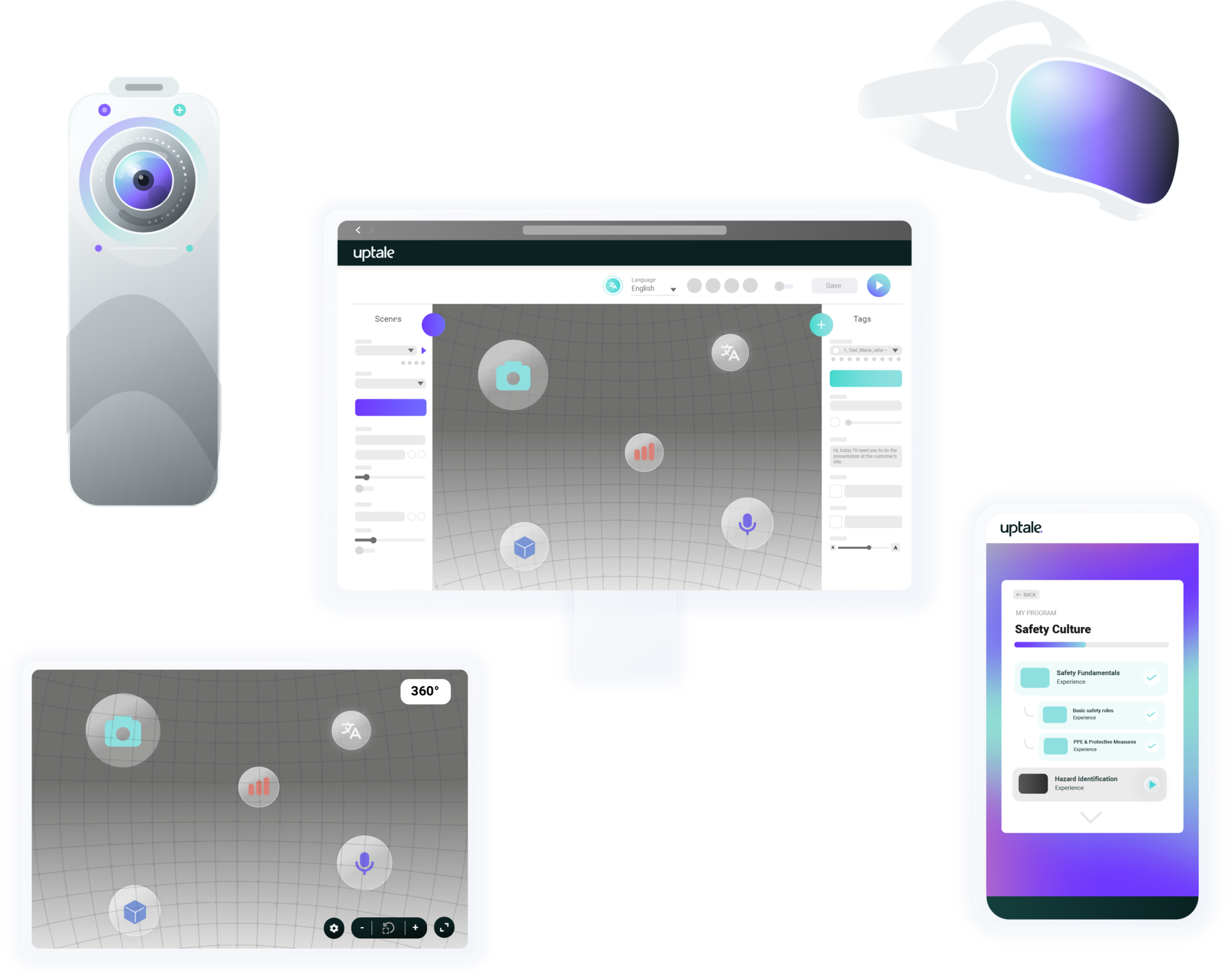
Its no-code authoring platform enables teams to transform 360° images and videos of real workplaces into interactive training experiences.
Learners can explore environments, identify hazards, practise procedures and make decisions within realistic scenarios. Experiences can be delivered through VR headsets, computers, tablets and smartphones. Want to see what this looks like? Try Uptale's VR demos.
Both platforms support interactive learning. The primary difference lies in how they represent the situations employees are preparing to face.
Reality, captured on site
- No-code authoring from 360° images and video of real workplaces
- Explore environments, spot hazards, practise procedures
- VR headsets, computers, tablets and smartphones
Control over digital courses
- Branching scenarios, variables and triggers
- Software simulations and interactive assessments
- AI-assisted authoring for instructional designers
Comparing Authoring, Simulations and Training Delivery
Storyline's support for interactive 360° images is worth noting. Authors can create panoramic activities using hotspots and markers.
However, Articulate's official documentation distinguishes these experiences from native VR training and 360° video, which Storyline does not currently support.
How Do They Support Employee Onboarding and Skills Development?
Effective employee onboarding involves more than sharing information. New hires must understand processes, equipment, workplace expectations and the tasks they will eventually perform.
Structured digital onboarding
Storyline provides a flexible environment for creating structured onboarding courses, software demonstrations and knowledge assessments.
Onboarding in the real workplace
Uptale brings another dimension to onboarding at scale by placing employees inside realistic representations of their working environments.
Safety Training and Operational Readiness: Different Approaches to Practice
Safety training often requires employees to apply procedures correctly in environments where mistakes can have serious consequences.
Storyline supports interactive safety courses through branching scenarios, decision-making activities and knowledge checks.
With digitized safety induction, Uptale enables training teams to recreate operational environments where learners can identify risks, recognize hazards and practise decisions in context.
Assessment, LMS Integration and Training Performance
Both platforms provide ways to evaluate learners and integrate training into existing enterprise systems.
Structured digital assessments
Advanced quiz creation, question banks, scoring and customizable assessments. Courses can be published to compatible learning management systems.
Scenario-based analytics
Quizzes, scenario-based interactions and learning analytics, including scores, time spent, learner paths and performance reports. LMS integration through standards and connection methods including SCORM and xAPI.
Uptale LMS integration guides
Step-by-step documentation from the Uptale Help Center.
The appropriate choice depends on what the organization needs to measure.
For knowledge acquisition and structured digital assessments, Storyline offers extensive authoring flexibility.
For training involving procedural decisions in realistic environments, Uptale can help teams analyze how learners progress through an immersive scenario.
From Content Creation to Multi-Site Deployment
Enterprise training teams must consider not only how content is created, but how it will be maintained and distributed across locations.
Storyline offers reusable slide content, collaborative review workflows and responsive course delivery.
Uptale provides browser-based no-code authoring, multilingual capabilities, multi-device deployment and offline playback. Teams can also draw on Uptale's guidance services and a ready-to-use training catalog.
Producing reality-based content may require access to physical locations and 360° filming. However, once the content is created, it can be reused across relevant training sessions and sites.
Choosing for Your Training Objectives: Onboarding, Compliance or Field Readiness
The choice between Uptale and Articulate Storyline 360 becomes clearer when starting with the intended training outcome.
Software training & knowledge assessment
For software training, structured digital courses and detailed knowledge assessments, Storyline offers extensive authoring control and established e-learning workflows.
Workplace familiarization & procedures
For workplace familiarization, operational procedures, hazard recognition and immersive skills practice, Uptale provides a dedicated reality-based training environment.
Consider Uptale →Knowledge, practice — or both
For compliance programs, the right approach depends on whether employees primarily need to demonstrate knowledge, practise applying procedures, or both.
Consider Both →The two platforms can also complement one another within a broader corporate training strategy.
Organizations may combine conventional e-learning with immersive scenarios to address different stages of employee development.
How organizations use Uptale in the field
Three examples of reality-based training applied to onboarding, safety-critical procedures and multi-site deployment.
Stellantis
Prepared new operators before they started on production lines, with expert-guided demonstrations of workstation procedures, safety requirements and quality standards.
Sources: technical training case · production-line case
Read the case study →Metro-North Railroad
Created immersive Blue Signal Protection training where employees experience the consequences of unsafe shortcuts and practise the correct procedures safely.
*Self-reported confidence, not independently tested competence. How they scaled it
Read the case study →Micron
Built a library of reality-based experiences for manufacturing operations, covering factory tours, manufacturing procedures and safety awareness.
See also: Uptale for manufacturing
Read the case study →Frequently Asked Questions
Does Articulate Storyline 360 support virtual reality?
Storyline supports interactive 360° images with hotspots and markers. However, Articulate's official documentation confirms that native VR experiences and 360° video are not supported.
Can Uptale be used without VR headsets?
Yes. Uptale experiences can be accessed through computers, tablets, smartphones and VR headsets, allowing organizations to select devices according to their training and deployment requirements. See all the ways to give learners access, or the player installation guides for Meta Quest and Pico 4 Enterprise.
Can Uptale replace Articulate Storyline 360?
Uptale can be considered for organizations prioritizing immersive, reality-based training. However, Storyline's specialized software simulations and advanced e-learning authoring capabilities serve different instructional requirements. The two solutions are not necessarily direct substitutes for every use case.
Can Uptale be integrated with an LMS?
Yes. Uptale experiences can be exported as SCORM packages (SCORM 1.2 or 2004) and uploaded to an LMS like any other course, although these packages play in a web browser rather than on VR headsets. For headset delivery and score reporting, LMSs supporting LTI 1.3, such as Moodle and Canvas, can connect directly to an Uptale environment. Learner results can also be recorded in an organization's own learning record store through xAPI. See Connect to your LMS for every option.
Can Uptale and Articulate Storyline 360 be used together?
Yes. The two platforms can complement one another within a broader corporate training strategy. Organizations may use Storyline for software training, structured digital courses and knowledge assessments, and Uptale for workplace familiarization, hazard recognition and procedural practice in reality-based environments. Both can be delivered through the same LMS.
Interested in bringing real workplace situations into your training programs?
Explore Uptale's reality-based training platform and discover how immersive experiences can support your workforce development objectives.